Before drying and curing, every Serrano ham must be manually tagged with a label that is injected into the meat. During this process, the operator must avoid hitting a bone. A Spanish robotics specialist has now fully automated this task for the first time – using artificial intelligence and a Stäubli robot.
Every Serrano ham must be labeled so that its progression through various drying chambers can be monitored and traced. Until recently, labeling could not be automated—but now it can: A Stäubli robot injects up to 900 labels per hour into the hams without hitting a bone. The correct position is determined using AI-powered vision systems.
A mid-sized producer of Serrano ham can process more than 5,000 hams per working day. This includes injecting each ham with a label that accompanies it throughout its journey of up to 18 months through various drying and curing rooms, ensuring full traceability and identification.
The challenge: Up to 40% of a ham’s weight consists of bone, which the label holder cannot penetrate. Since ham is a natural product, the position of the bones varies from one piece to another. Labeling therefore requires both experience and significant physical effort. This is why there has long been a desire to automate this step, but it was not feasible, as the position of the bones within each ham could not be determined with the speed and accuracy required.
Timpolot, an automation specialist based in Olot, a meat production hub in eastern Spain, has found a reliable solution for labeling. It consists of a Stäubli robot combined with a label applicator and AI-powered vision system. Jordi Bassols, founder and General Manager of Timpolot, explains the process: “The hams are manually placed on a conveyor belt in random order. The vision system identifies their position and, using algorithms and supportive AI, determines the ideal labeling point in the meat, which the robot then precisely targets.”
Meanwhile, a printer prepares a plastic label, which the robot picks up using a pneumatic fastening applicator. Guided by coordinates from the camera, it inserts the needle-like label holder into the ham without hitting a bone, reducing the risk of needle breakage.
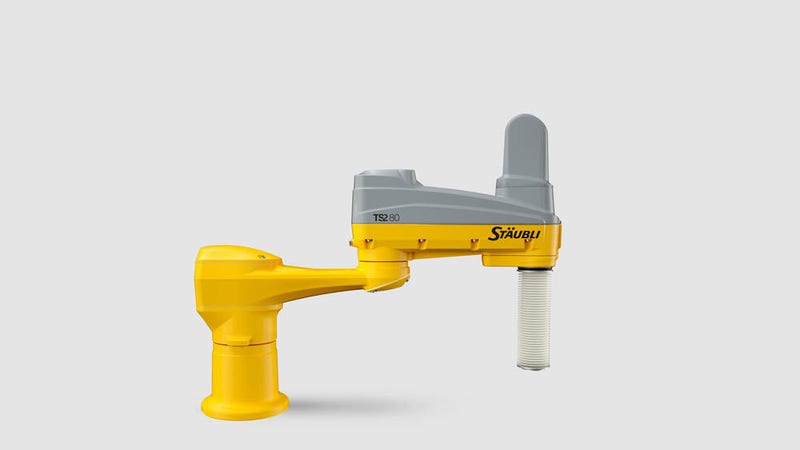
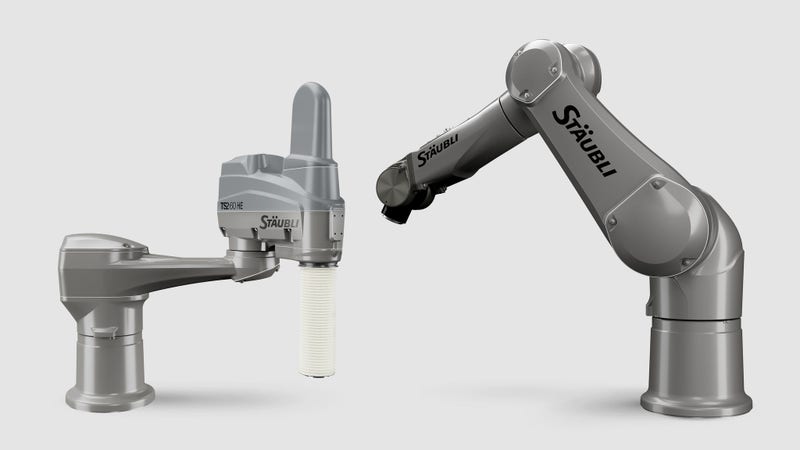
The first of these systems is already in operation at a major Serrano ham producer. The SCARA robot, a Stäubli TS2-80 HE, processes between 150,000 and 180,000 kg of ham per day, with a continuous output of 750 units per hour and a peak rate of up to 900 units per hour. The cycle time is therefore just four seconds.
“With automated labeling, we address several areas: first, improving work quality and occupational safety while enabling operators to focus on higher-value tasks, and second, enhancing traceability through centralized data management,”
says Founder and General Manager Jordi Bassols.
TS2-80
The TS2-80 offers extended reach and high accuracy with a hygienic IP65 arm, suited for midrange operations. Reach: 800 mm — payload: 8.4 kg.
Hygienic & humid environments
Designed for humid environments, Stäubli's HE robots are the benchmark for the food industry and parts cleaning operations.